
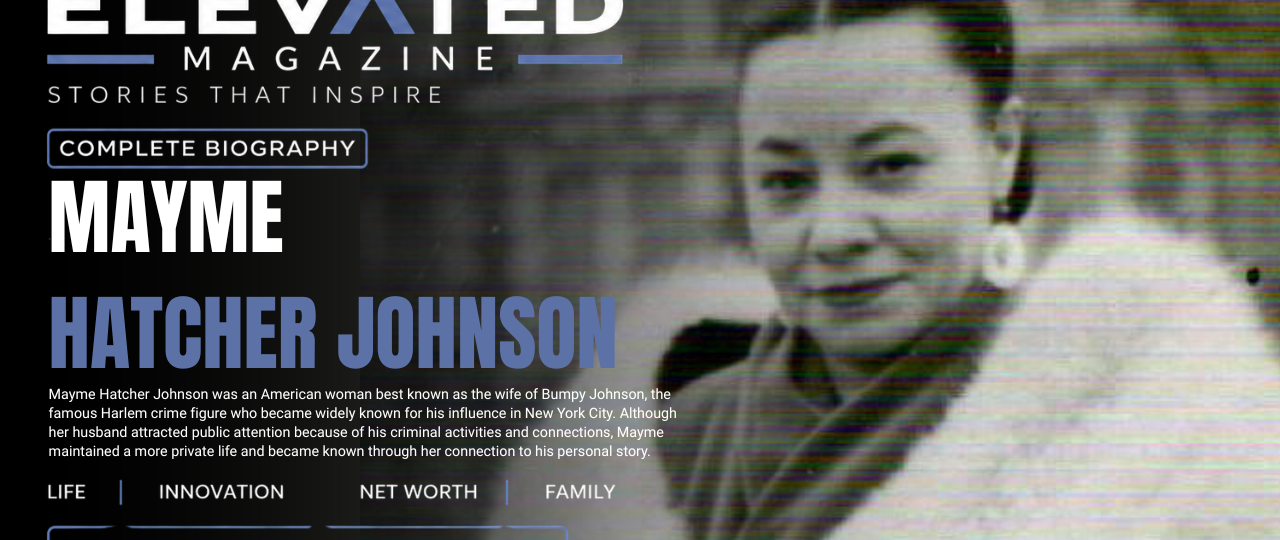

Mayme Hatcher Johnson is remembered for her marriage to Ellsworth “Bumpy” Johnson, one of Harlem’s most notorious underworld figures, but her own story extends beyond the reputation of the man she married. She lived through decades of change in New York, witnessed a complicated chapter of Harlem’s history firsthand, and eventually helped tell that story in a book published when she was in her nineties.
For readers searching Mayme Hatcher Johnson’s net worth, the most important fact is that no reliable public record establishes her exact wealth. Websites that attach a specific dollar figure to her name should be treated cautiously: her finances were not publicly documented in a way that supports a dependable estimate.
There are, however, meaningful details about her life that help explain the question. Johnson experienced the privileges associated with her husband’s underworld status, lived for more than four decades after his death, and became a published author late in life. Understanding those facts offers a clearer picture than an unsupported net-worth number ever could.
Mayme Hatcher Johnson: Biography at a Glance
| Detail | Information |
|---|---|
| Full name | Mayme Hatcher Johnson |
| Commonly known as | Mayme Johnson |
| Birth year | 1914, according to published obituaries |
| Exact date of birth | Not consistently confirmed by strong biographical sources |
| Birthplace | North Carolina, according to published biographical accounts |
| Nationality | American |
| Known for | Her marriage to Bumpy Johnson and her account of his life |
| Husband | Ellsworth “Bumpy” Johnson |
| Marriage | 1948 |
| Children | One daughter, Ruthie Johnson, with Bumpy Johnson, according to biographical accounts |
| Profession | Author; previously worked as a waitress |
| Notable book | Harlem Godfather: The Rap on My Husband, Ellsworth “Bumpy” Johnson |
| Book publication | 2008 |
| Date of death | May 1, 2009 |
| Age at death | Reported as 94 |
| Net worth | Not publicly verified |
The biographical details above draw on published obituaries and catalog records. Some online profiles provide a precise birthday, but the strongest sources consulted for her life and death do not consistently establish that exact date.
What Was Mayme Hatcher Johnson’s Net Worth?
There is no verified figure for Mayme Hatcher Johnson’s net worth. No reliable financial disclosure, estate valuation, or well-documented accounting of her assets has been identified that would establish how much money she owned during her lifetime or when she died.
That distinction matters because many celebrity and biography websites publish net-worth figures without showing how they were calculated. A number can be repeated across several pages and still have no dependable evidence behind it. In Johnson’s case, a precise estimate would be especially difficult to support because much of the public interest in her finances comes from her connection to Bumpy Johnson rather than from a documented business career of her own.
Why her wealth is difficult to calculate
Johnson was not a public-company executive whose compensation could be tracked through corporate filings, nor was she a modern celebrity whose endorsement deals, business holdings, and public contracts might be widely reported. Her life took place largely outside the financial transparency associated with those careers.
Several questions would need answers before anyone could responsibly calculate her net worth:
- What property or financial assets did she personally own?
- Did she receive income from any investments or other private arrangements?
- What financial resources remained available to her after her husband’s death in 1968?
- How much income, if any, did her 2008 book generate?
- What assets and liabilities were recorded in her estate when she died?
The available biographical sources do not provide a complete answer to those questions. Without that information, an exact figure would be speculation rather than financial reporting.
Did Mayme inherit Bumpy Johnson’s fortune?
It is understandable that readers ask whether Johnson inherited a substantial fortune from her husband. Bumpy Johnson was widely known as a powerful figure in Harlem’s criminal underworld, and his reputation has encouraged stories about money, influence, and luxury.
But a reputation for criminal power is not the same thing as proof of a specific personal fortune. Nor does it establish that all money associated with a criminal organization belonged to one individual, remained available at his death, or passed to his spouse.
Johnson’s published recollections describe the material advantages she experienced as Bumpy’s partner, including gifts and jewelry. Those recollections are useful evidence of how she remembered their life together, but they do not establish the value of her possessions, what she retained after his death, or whether she inherited a large estate.
The most accurate conclusion is therefore straightforward: Mayme Hatcher Johnson’s net worth remains unknown. Claims assigning her a precise fortune should not be treated as established fact unless they are supported by credible financial documentation.
Who Was Mayme Hatcher Johnson?
Mayme Hatcher Johnson became publicly known through her marriage to Bumpy Johnson, but she also had a life of her own before and after that relationship.
Published obituaries report that she was born in North Carolina in 1914 and moved to New York City in 1938. She found work as a waitress in a club owned by singer and actress Ethel Waters. That job placed her in a social environment connected to entertainment and nightlife, although the available biographical record offers limited detail about her life before she met her future husband.
Her later public identity became closely tied to Harlem, the New York neighborhood that played an important role in her adult life. Harlem had a rich cultural history, shaped by Black artistic achievements, political activism, community institutions, and vibrant nightlife. The neighborhood was also known for its complex social environment, where influential figures and local businesses helped shape everyday life. Its cultural diversity and strong community connections made Harlem an important part of her personal story.
Mayme’s story sits at the intersection of those worlds. She was not primarily known as a criminal operator herself; her significance to the historical record comes largely from her perspective as the wife of a prominent underworld figure and, eventually, as someone who helped document his life.
That perspective matters. Stories about notorious men often focus on rivalries, arrests, and criminal enterprises. The people who lived alongside them can provide a different view: what their private relationships looked like, how their reputations shaped daily life, and how those relationships were remembered after the headlines faded.
Johnson’s later book gave readers access to some of that personal perspective.
Mayme Hatcher Johnson and Bumpy Johnson’s Relationship
Mayme Hatcher met Ellsworth “Bumpy” Johnson in Harlem in 1948. The two married that year, according to published accounts. She was 34 at the time, based on the age and marriage date reported in The Philadelphia Inquirer. Their marriage lasted until Bumpy’s death in 1968.
Bumpy Johnson had already developed a formidable reputation by the time they married. He was associated with Harlem’s organized-crime networks and was known for his connections with influential figures in the neighborhood. His activities and personal life attracted public attention, making him a well-known figure in Harlem’s history. His life has since been retold in books, films, and television dramas, sometimes with considerable artistic license.
For Mayme, being his wife meant living alongside that reputation. In an account published around the release of her book, she described the social privileges attached to the relationship, including access to places and the receipt of gifts and jewelry. Her recollections suggest that Bumpy’s standing could translate into visible material comforts, but they should be understood as personal testimony rather than a full accounting of the couple’s finances.
Their marriage also unfolded during a period when Bumpy faced serious legal consequences. In 1954, he was sentenced to 15 years in prison on a drug-conspiracy charge. He was paroled in 1963 and died five years later, in 1968, after suffering a heart attack while dining at a Harlem restaurant.
Those events shaped the circumstances of Mayme’s married life. They also explain why a discussion of her finances cannot simply assume that her husband’s public reputation translated into a large, lasting inheritance. His criminal activity, imprisonment, and death are documented; the exact state of his finances and the value of any assets that Mayme personally retained are not established by the sources available here.
Did Mayme Hatcher Johnson Have Children?
Published biographical accounts identify Ruthie Johnson as the daughter of Mayme and Bumpy Johnson. Bumpy also had a daughter, Elease Johnson, from an earlier relationship, whom Mayme is described as having been a stepmother to.
Beyond those basic details, the reliable public record about the family is limited. It is important not to fill those gaps with unsourced claims about private relationships, inheritance arrangements, or family wealth.
The existence of children does not establish who inherited particular assets, whether an estate was substantial, or how any property may have been distributed. Those questions require documentary evidence, such as probate records or reliable reporting based on estate documents. The biographical sources cited here do not provide a verified estate valuation for Mayme Johnson.
This is one reason her net worth is difficult to establish retrospectively. A family connection to a well-known figure can generate widespread curiosity, but it does not automatically make a person’s financial affairs public knowledge.
Mayme Hatcher Johnson’s Career Before Writing Her Book
Johnson did not become widely known through a conventional entertainment career. She was not a film star, television personality, or recording artist. Her documented working life included employment as a waitress before and around the period when she became associated with Bumpy Johnson.
Her public legacy developed much later, through her decision to tell the story of her husband.
The distinction is important when considering her potential sources of income. A long career in entertainment or business might leave behind a trail of contracts, salary reports, company records, and other financial evidence. Johnson’s public biography does not provide a comparable record. Her most clearly documented publishing milestone came near the end of her life.
That does not mean her contribution was insignificant. In fact, her value as a source comes from the unusual position she occupied: she knew Bumpy personally and could write about aspects of his life that a distant researcher could not observe directly.
Personal recollection, of course, is not identical to independent verification. A memoir can illuminate experiences and relationships, but its claims may still need to be compared with contemporary records and other accounts. That is particularly relevant when the subject is a figure whose life has been surrounded by myth, conflicting memories, and dramatized retellings.
Harlem Godfather: The Book That Preserved Her Perspective
Book: Harlem Godfather: The Rap on My Husband, Ellsworth “Bumpy” Johnson
Authors: Mayme Hatcher Johnson and Karen E. Quinones Miller
Publisher: Oshun Publishing Company
Publication year: 2008
Length: 244 pages
Bibliographic details are recorded by Google Books and the Free Library of Philadelphia.
Published in 2008, Harlem Godfather became the most important documented work associated with Mayme Johnson’s name. She worked with author Karen E. Quinones Miller to tell the story of Bumpy Johnson, combining biographical material with her own recollections of their life together.
The book covers more than the public image of a feared Harlem crime figure. Its subject includes Bumpy’s personal life, his place in Harlem’s underworld, and his relationship with other people who shaped the period. The catalog description also highlights the book’s treatment of Stephanie St. Clair, a prominent Harlem numbers operator, and Bumpy’s relationship with Frank Lucas.
Johnson’s involvement made the book especially interesting to readers trying to separate the man from the legend. Someone who shared a home and a marriage with a public figure can offer a perspective unavailable in police reports or newspaper coverage alone. At the same time, readers should approach any first-person account as one perspective within a larger historical record, not as the final word on every disputed event.
What did the book contribute to her legacy?
First, it preserved Mayme’s account of a relationship that had attracted public fascination for decades. Second, it placed her name on a published work rather than leaving her remembered solely as someone’s wife. Third, it offered later writers and audiences another source to consider when reconstructing Bumpy Johnson’s life.
The book’s publication also helps explain why searches for Mayme Hatcher Johnson continue. People encountering stories about Bumpy Johnson often want to know about his family, his marriage, and the people who knew him outside his criminal reputation.
The book is a documented professional milestone, but its publication alone does not establish how much money Johnson earned. The available catalog records confirm its publication details, not her royalties, sales totals, or personal income from the project.

Did Mayme Hatcher Johnson Earn Money From Her Book?
It is reasonable to assume that a traditionally published book may generate author income through advances or royalties, depending on the publishing agreement. But that general industry practice does not prove what any particular author received.
No reliable public source identified here discloses Johnson’s advance, royalty rate, total book sales, or overall earnings from Harlem Godfather. Nor is there sufficient evidence to calculate how much of any publishing income she personally received under the arrangement with her co-author and publisher.
The book was published in 2008, when Johnson was in her nineties. An obituary in The Philadelphia Inquirer described her pride in being able to call herself an author at age 93. That detail offers a more solid picture of what the book meant to her personally than an invented royalty estimate would.
Her work should therefore be recognized as a meaningful late-life achievement without overstating its financial consequences. It expanded her public identity and preserved a firsthand account, but the size of any resulting income remains unknown.
What Happened to Mayme Hatcher Johnson After Bumpy Johnson Died?
Bumpy Johnson died on July 7, 1968, after suffering a heart attack in Harlem. Mayme survived him by more than 40 years, a period during which the world that had made her husband notorious continued to change.
She eventually moved to Philadelphia. Published obituaries report that she relocated there in the early 2000s, with sources differing slightly on whether the move occurred in 2003 or 2004. She spent her final years there, away from the Harlem setting most closely associated with her husband’s reputation.
Her later life is notable partly because she did not publish her best-known book until 2008. By then, she was in her nineties. The book brought her memories to a wider readership shortly before her death.
Mayme Hatcher Johnson died on May 1, 2009, at the reported age of 94. Contemporary obituaries attributed her death to respiratory failure or heart failure, depending on the report. Those differences in the wording of the reported cause do not affect the central biographical facts: she died in Philadelphia in 2009, more than four decades after her husband.
Her long life after Bumpy’s death is relevant to questions about her finances, but it does not provide an answer by itself. There is no verified public accounting of her assets over those decades, and it would be misleading to assume that she retained her husband’s wealth throughout that time.
Mayme Hatcher Johnson’s Connection to Godfather of Harlem
Mayme Johnson’s story has gained renewed visibility through screen portrayals of the Harlem underworld. In the television drama Godfather of Harlem, actress Ilfenesh Hadera plays Mayme Johnson, while Forest Whitaker portrays Bumpy Johnson. The series brings the couple’s relationship to audiences who may not have encountered the historical figures before.
Dramatizations can spark genuine interest in historical people, but they also create a problem: viewers may assume that every scene, relationship detail, financial arrangement, or personal exchange reflects the historical record.
That assumption is risky with a figure such as Mayme. Television narratives must compress timelines, construct dialogue, and shape events into a dramatic story. A character’s lifestyle on screen cannot be used as evidence of the real person’s net worth.
The same caution applies to online articles that mix documented history with dramatic retellings. If a show depicts lavish gifts or a particular standard of living, those scenes don’t establish the value of assets that Mayme actually owned. Her own published recollections provide historical context, but they do not offer a complete balance sheet.
For readers interested in the real Mayme Hatcher Johnson, the most useful approach is to treat television as an entry point and rely on contemporary reporting, biographical records, and her book for historical context.
Why Do People Search for Mayme Hatcher Johnson’s Net Worth?
Several factors may explain interest in her finances.
1. Bumpy Johnson’s reputation for wealth and power
Bumpy Johnson’s name is associated with Harlem’s criminal underworld and organized crime. His reputation naturally leads to questions about money, including how much wealth he controlled, what he owned personally, and what happened to his assets after his death.
Those are understandable questions, but they require financial evidence. Stories about influence and luxury are not substitutes for records establishing personal wealth.
2. Her life as the wife of a famous underworld figure
Mayme’s own recollections describe a life in which her husband’s standing brought social privileges and expensive gifts. Such accounts can lead readers to wonder whether she remained wealthy after his death. Yet there is a difference between enjoying a lifestyle during a marriage and independently owning assets that can be valued decades later.
3. The publication of her book
Harlem Godfather introduced a new generation of readers to Mayme as an author and firsthand witness. Publishing a book can generate income, but without sales figures and contract details, it is impossible to calculate the financial impact of her work.
4. Renewed interest from television and film
Screen portrayals of Bumpy Johnson and the wider Harlem underworld have kept public curiosity alive. People often search for the families of historical figures after watching a dramatization, including questions about spouses, children, and inheritance.
That attention explains why Mayme’s name remains relevant in online searches. It does not make unverified wealth estimates more reliable.
Confirmed Facts vs. Unverified Claims About Her Wealth
| Claim | What the available evidence supports |
|---|---|
| Mayme was married to Bumpy Johnson | Confirmed by published biographies and obituaries |
| She experienced material privileges during their relationship | Described in her own recollections as reported in contemporary coverage |
| She published a book about Bumpy Johnson | Confirmed; Harlem Godfather was published in 2008 |
| She earned a specific amount from the book | Not publicly verified |
| She inherited a particular sum after Bumpy’s death | Not established by the reliable sources consulted |
| She owned a specific amount of jewelry or property at death | No dependable valuation identified |
| Her exact net worth can be stated in dollars | Not supported by verified financial records |
The distinction between a confirmed life event and an unverified financial claim is essential here. Marriage, publication dates, and death records can be documented. A person’s net worth requires evidence about assets, liabilities, ownership, and income.
Interesting Facts About Mayme Hatcher Johnson
- She became a published author in her nineties. Her best-known book appeared in 2008, shortly before her death.
- Her book was written with Karen E. Quinones Miller. The publication credits both women, so it is more accurate to describe it as a co-authored work than to ignore the collaboration.
- She had a long life after her husband’s death. Bumpy died in 1968, while Mayme died in 2009.
- She had a working life before her public association with Bumpy. Obituaries report that she worked as a waitress in a club owned by Ethel Waters.
- Her perspective helped broaden the story. Rather than focusing exclusively on criminal activity, her book also addressed Bumpy’s personal life and relationships.
These details help explain her significance without turning her life into a story solely about money or her husband’s notoriety.

Frequently Asked Questions
1. What was Mayme Hatcher Johnson’s net worth?
Mayme Hatcher Johnson’s exact net worth is not publicly verified. There is no dependable financial record establishing the value of her assets or estate, so precise figures circulated online should be treated as unconfirmed estimates.
2. How did Mayme Hatcher Johnson make money?
Published accounts identify her early work as a waitress and her later role as a co-author of Harlem Godfather: The Rap on My Husband, Ellsworth “Bumpy” Johnson. Her full income history is not publicly documented, and her earnings from the book have not been reliably disclosed.
3. Was Mayme Hatcher Johnson married to Bumpy Johnson?
Yes. Mayme married Ellsworth “Bumpy” Johnson in 1948. Their marriage lasted until his death in 1968.
4. Did Mayme Hatcher Johnson inherit Bumpy Johnson’s fortune?
There is insufficient reliable evidence to establish the amount of money or property she inherited, if any. Her husband’s criminal reputation and reports of his lifestyle do not establish the value of assets he owned at death or what passed to his family.
5. Did Mayme Hatcher Johnson write a book?
Yes. She co-authored Harlem Godfather: The Rap on My Husband, Ellsworth “Bumpy” Johnson with Karen E. Quinones Miller. Published in 2008, the book recounts aspects of Bumpy’s life and their relationship.
6. How old was Mayme Hatcher Johnson when she died?
Published obituaries reported that she was 94 when she died on May 1, 2009. Those sources identify her birth year as 1914, although the exact date of birth is not consistently confirmed by the strongest sources consulted.
7. Did Mayme and Bumpy Johnson have children?
Biographical accounts identify Ruthie Johnson as their daughter. Bumpy also had a daughter named Elease from an earlier relationship, and Mayme is described in some accounts as her stepmother.
8. What was Harlem Godfather about?
The book explores Bumpy Johnson’s life, his place in Harlem’s underworld, and aspects of his private life as recalled by Mayme. It also discusses other figures connected to Harlem’s criminal history. The book is a valuable personal account, although its recollections should be considered alongside other historical evidence.
9. Where did Mayme Hatcher Johnson live after Bumpy’s death?
She eventually moved to Philadelphia after spending much of her life associated with Harlem. Published obituaries place her in Philadelphia during her final years, where she died in May 2009.
10. Is Mayme Hatcher Johnson portrayed in Godfather of Harlem?
Yes. Actress Ilfenesh Hadera portrays Mayme Johnson in the television drama, with Forest Whitaker playing Bumpy Johnson. The show is a dramatization, so its scenes should not be treated as a fully factual record of Mayme’s life or finances.
Final Thoughts
Mayme Hatcher Johnson’s life is closely connected to one of Harlem’s best-known criminal figures, but reducing her story to a net-worth estimate misses what makes her worth remembering. She was a wife, a witness to a turbulent period in Harlem’s history, and a co-author who helped preserve her perspective on Bumpy Johnson’s life.
Her financial circumstances remain uncertain. There is no verified figure that can responsibly be presented as her net worth, and neither her husband’s reputation nor her later book provides enough information to calculate one. Any article claiming an exact amount without credible supporting records should be approached with caution.
What can be said with confidence is that Mayme’s legacy extends beyond questions of inheritance and money. Her book gave readers another way to understand a man whose public image often overshadowed the people who knew him personally. For anyone interested in the real history behind Harlem’s underworld stories, that contribution is more meaningful than an unsupported dollar figure.